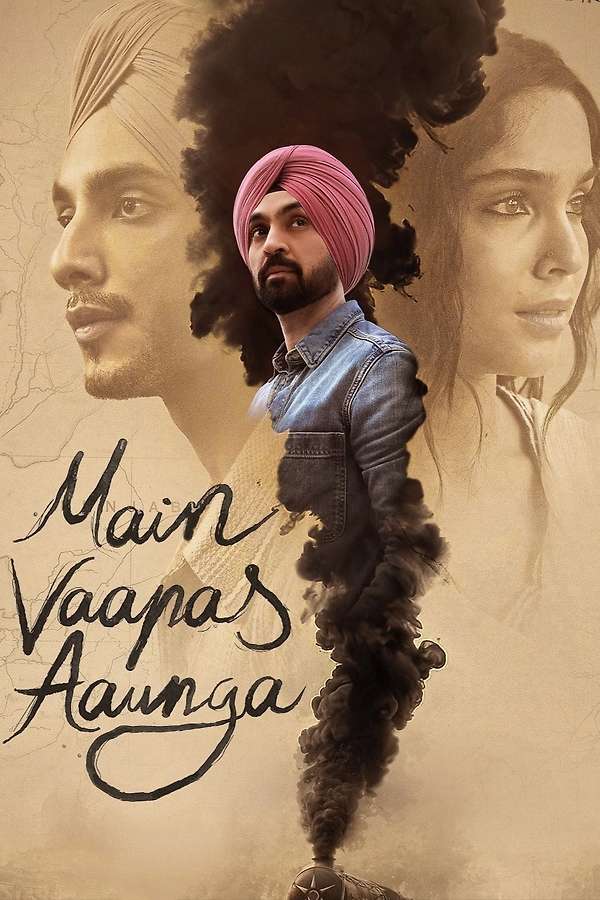
Main Vaapas Aaunga
2026
🎯 Verdict
✍️ Full Review
Diljit finds his roots by going down Naseeruddin's memory lane, the same Tara Singh-Sakeena lane Bollywood somehow couldn't go beyond. Some dark chapters of bloodsoaked history doesn't always have to be painted with Valentine Red. I seriously thought with Amar Singh Chamkila, Imtiaz Ali must be past his usual hang-ups of the side plot of Love Aaj Kal but here he comes with another young love lost in the backdrop of partition. Bollywood's gotta make a pact of some kind along the line of- "If not a solidly extraordinarily unique script, we shouldn't touch the wounds of partition again." I mean more than five hundred thousand to two million people lost their lives and around five million to ten million people got displaced, yet somehow plot after plot gets revolved around one man's personal desires and/or ambitions. Certainly in a grand scheme of things, somewhere one has to trump the other. And it's not even a one-off idea for which a pass may as well be given here, it's time and again we come across the similar stories and the same type of devices, where past ruins and trauma comprising socio-cultural and political orders to further overused tropes so that the bleeding heart strings of the viewers could be tugged. How have we not become sick of it that I fail to figure out. One consistent theme of Imtiaz's that runs through almost all his movies remains intact in Main Vaapas Aaunga too and that is a restless protagonist who can't find his place in the world for which he keeps running away from circumstances in search of the self and personal identity. Whether it's Shahid in Jab We Met or Saif in Love Aaj Kal or Alia in Highway or Ranbir in Rockstar and Tamasha, it's always been there perpetually. Ali maintains that to the letter here but with a two-pronged approach this time. One younger, one old both running away from situations in their own ways consistent with their times and respective generational angst. Rahman tries to put his magic in the midst of all these but I would say it's rather very unnoticeable this time unlike his previous stints with Imtiaz where the soundtrack and background score used to weave their own themes and characters into the premise. The whole screenplay going back and forth in time with an oversaturated presence of flashbacks which I admit has been sort of a trademark style of the director is getting real trite and stale by now. At least with his previous exploits, Imtiaz used to insert good dialogue writing that enriched his storytelling and somehow in this latest project of his, somehow he managed to throw even that with the most banal lines that turned out to be a real travesty, delivered and acted out atrociously by two fairly newcomers. Shoddy crammed editing also marred the narrative aspects by overwhelmingly stitching everything that must be shot, by not applying brevity. Even Diljit's stand-up set was a complete bust with those customary formal laughs and don't even start with the forced Swades subplot in the middle of all this. Many a times, showing less and giving space to the audience to work out the rest in their minds is a better more elegant choice. These movies don't need to be 165 minutes long. We need something like a Hotel Rwanda or Quo Vadis, Aida? to address these historically sensitive subjects and it's a foregone conclusion that should have been entered into our collective consciousness that it's about time we realize that we are grownups now in terms of cinema literacy and these difficult subjects don't need to be shoehorned or diluted or palatable by mixing it up with only love stories. This one meanders two-third of its runtime and then suddenly, it turns a corner and reaches the point it wants to comes across. By then, I had already ran out of patience. For brief moments, Main Vaapas Aaunga taps into the right notes reminding us that even though it's been around 80 years and most of us weren't around that time to have any memories, how for some old-timers the trauma still remains as fresh as the day of having to lose their land and neighborhood. While most of the countries post-fragmentation were joyous and couldn't contain their happiness whose source was attached to the newly achieved freedom and the sense of independence, crores of people were mourning and couldn't participate in that celebration due to the unbearable pain and anguish they had to experience witnessing a scale of savagery that still creeps its way among the various communities today. Another theme of the movie that has to be mentioned here is about tribalism, the ancient source of evil that turns one brother of the community against another and burns down centuries worth of harmonious coexistence which also happens to be a global source of bane, whether it was Germany, Bosnia, Sri Lanka, Indonesia, Timor, China, Myanmar, Rwanda or other countries across the six continents similar to the black spot in the history of the formation of India, Pakistan and Bangladesh. You know what? Read Hannah Arendt's The Banality of Evil or Ordinary Men by Christopher Browning or Amrita Pritam to expand the foundational background information. Apart from pulling on that thread, this film fails to bring anything new to the already cluttered table. Yet, despite everything Naseer Sahab's still got his shine.